Your company has a polished website, years of experience and a respectable collection of service pages.
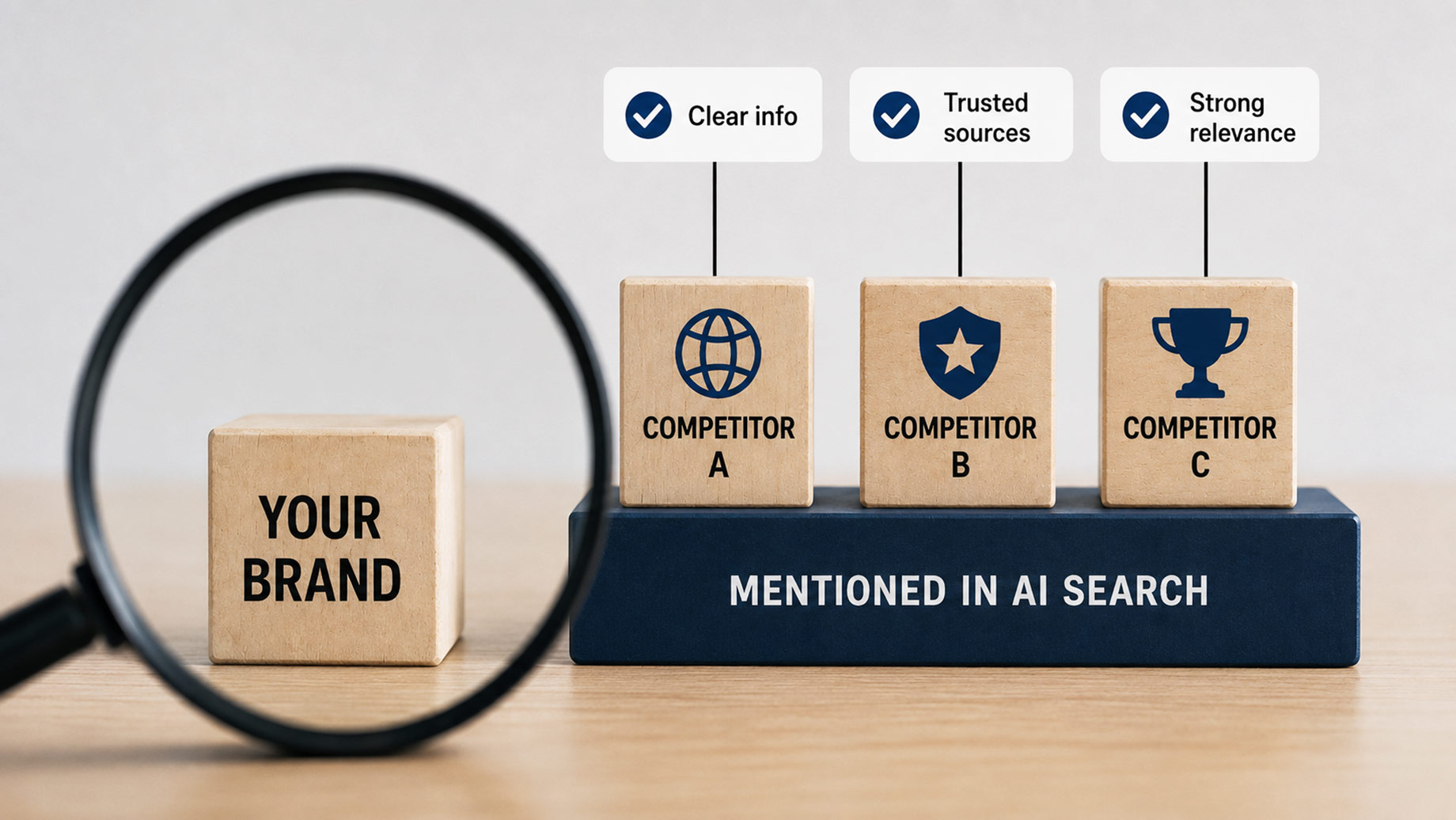
Yet when someone asks an AI search tool to recommend providers in your industry, the answer mentions three competitors and ignores your business completely.
One competitor has fewer employees. Another has a website that looks as though it was last redesigned when gradient buttons were considered futuristic. Somehow, both brands keep appearing while yours remains digitally invisible.
This can feel random, but it usually is not.
AI-powered search systems need accessible, relevant and trustworthy information before they can confidently mention or cite a business. They may consider information from company websites, conventional search indexes, videos, forums, business profiles, publications and other sources across the web.
If competitors provide clearer evidence, stronger topic coverage and more consistent external validation, they become easier to retrieve and describe.
A capable GEO agency in Singapore should therefore do more than add frequently asked questions to your website and rename the exercise “AI optimisation”. It should identify why competitors are more discoverable, strengthen the evidence supporting your brand and measure whether that work improves visibility across relevant prompts.
This guide explains why AI search may mention your competitors while overlooking your business and what you can do about it.
How AI Search Chooses Which Brands to Mention
AI search does not behave exactly like a traditional list of search results.
Instead of displaying only ranked links, a generative system may interpret a question, retrieve relevant information and produce a summarised answer. Depending on the platform and query, that answer may include citations, recommendations, comparisons or descriptions of particular businesses.
The systems and interfaces vary.
Google states that its generative AI search features remain rooted in its core Search ranking and quality systems. Pages must meet ordinary technical requirements, be indexable and remain eligible to appear with snippets before they can be considered for these experiences.
ChatGPT search can retrieve timely information from the web and provide links to relevant sources. OpenAI also allows publishers that permit OAI-SearchBot to access their content to track referral traffic from ChatGPT through analytics platforms.
This means your visibility depends on more than inserting a few fashionable terms into your copy.
The system must be able to access your information, understand what your company does and find enough reliable evidence to justify including it in an answer.
Your competitors may simply be making that job easier.
1. Your Website Does Not Clearly Explain What Your Business Does
Many websites describe their companies using language that sounds professional but communicates very little.
They offer “innovative solutions”, “customer-centric strategies” and “transformative experiences”. These phrases may survive several management reviews, but they do not clearly identify the services, customers or problems involved.
AI systems cannot confidently recommend a business when its positioning is vague.
Your website should state what you provide, who you serve and where you operate. Important details should appear in normal page content rather than being hidden inside images, downloadable brochures or decorative animations.
Suppose you operate a B2B cybersecurity consultancy in Singapore.
Your homepage should make that category clear. It should explain whether you provide penetration testing, compliance assessments, managed security services or incident-response support.
If a competitor clearly documents those capabilities while your website promises to “secure tomorrow through digital excellence”, the competitor provides more useful evidence.
A professional generative engine optimisation agency should begin by reviewing whether your brand can be understood quickly and accurately.
Before asking why AI ignores your company, make sure your website has introduced it properly.
2. Your Competitors Cover More of the Customer’s Questions
AI search queries are often conversational and highly specific.
A user may ask for the best accounting provider for a foreign-owned SME, a suitable logistics partner for temperature-sensitive goods or a marketing firm experienced in regional B2B campaigns.
A generic service page may not contain enough information to support these answers.
Competitors that publish detailed guides, comparisons, case studies and frequently asked questions create more opportunities to match specialised prompts. They establish connections between their brand, services, industries and customer situations.
This does not mean your company should publish an article for every imaginable question.
It means your content should cover the important themes surrounding the problems you solve. Service pages can explain capabilities, while supporting articles address processes, costs, risks, comparisons and decision criteria.
Google’s current guidance recommends creating unique, reliable and people-first material that adds value beyond information already available everywhere. It specifically advises businesses to prioritise non-commodity, expert-led content rather than chasing special GEO tricks.
A strong AI search content strategy should therefore map the questions customers ask at different stages.
Your competitors may not be more qualified.
They may simply have published better answers to the questions AI systems are being asked.
3. Your Content Repeats What Everyone Else Already Says
Publishing more content does not automatically make a brand more visible.
If every article summarises the same common advice, your website contributes very little new evidence. AI systems can retrieve similar information from dozens of other sources.
This is particularly common when companies produce high volumes of generic articles.
The titles may target relevant keywords, but the content contains no original examples, data, methodology or professional insight. The article technically exists while giving readers and retrieval systems no compelling reason to prefer it.
Google warns that producing large amounts of AI-generated content without adding meaningful user value may violate its policy against scaled content abuse.
Useful differentiation can come from first-hand experience.
Your company might publish original survey findings, anonymised campaign data, project lessons, local regulatory explanations or detailed frameworks developed through client work.
Subject-matter experts can explain where common advice fails and what businesses should consider in practice.
An experienced GEO content agency should help transform internal expertise into material that is genuinely difficult for competitors to reproduce.
A thousand generic words may fill a publishing calendar.
One credible insight gives the brand something worth citing.
4. Your Brand Lacks Third-Party Validation
A company website will naturally describe the business positively.
External sources provide independent context.
Industry publications, professional associations, reputable directories, event pages, interviews, customer reviews and relevant partner websites can reinforce what the company claims about itself.
If competitors are consistently mentioned across credible websites, AI search systems have more evidence connecting their brands with the topic.
This does not mean companies should manufacture mentions across low-quality websites.
Google explicitly cautions against seeking inauthentic mentions as a shortcut for visibility. Its systems continue to focus on high-quality content and spam prevention, including within generative AI search features.
The better approach is earning legitimate visibility.
Companies can contribute expert commentary, release useful research, collaborate with industry groups and publish case studies with clients where appropriate.
A strong digital PR and GEO strategy should prioritise topical relevance and credibility rather than raw mention volume.
Your competitor may be included because ten useful sources independently connect its brand with a service category.
Your own website repeating “industry leader” twenty times does not create the same effect.
5. Your Business Information Is Inconsistent
AI search may encounter several versions of your company information.
Your website lists one service offering. Your business profile uses an outdated address. An old directory includes a previous company name, and a media article refers to a service that was discontinued three years ago.
These contradictions make the brand more difficult to describe accurately.
Basic company information should remain consistent across important sources.
This includes the brand name, location, service categories, contact information and core positioning. Larger businesses should also document office locations, leadership and regional operations clearly.
Consistency does not require every profile to contain identical wording.
It requires the underlying facts to agree.
Local businesses should maintain an accurate Google Business Profile where applicable. Google notes that Business Profiles and Merchant Center data can support the appearance of local business and product information across conventional and generative search experiences.
A GEO agency in Singapore should audit the brand’s digital footprint before attempting complicated optimisation.
AI cannot confidently repeat information when the company appears uncertain about its own address.
6. Search Engines Cannot Access Important Pages
Your strongest content provides no visibility if crawlers cannot reach or index it.
Pages may be blocked by robots directives, marked with a noindex tag or buried behind scripts that make important content difficult to process. Incorrect canonical tags can also tell search engines to treat another URL as the preferred version.
Google explains that its generative search features draw from the Search index. A page must satisfy the usual technical requirements and remain eligible to appear in Search before it can participate in these experiences.
Other AI search tools may use their own crawlers or retrieval partners.
OpenAI states that publishers can control access for OAI-SearchBot. Blocking the search crawler can limit the ability of ChatGPT search to access and link to site content.
A proper AI search visibility audit should review crawler access, indexation, canonical tags, internal links and server responses.
The technical goal is not to create a secret AI-only website.
It is to ensure that legitimate search systems can access the same useful content available to users.
Before rebuilding the content strategy, confirm that the existing pages are not standing behind a locked digital door.
7. Your Important Information Is Hidden in Unhelpful Formats
Businesses often place valuable information inside PDF brochures, images, interactive tools or video content without useful supporting text.
Search systems may still discover some of these formats, but important facts become harder to retrieve consistently when they are not presented clearly in accessible page content.
For example, your pricing approach may appear only inside a graphic.
Your project process may be contained within an animated timeline. Your strongest case study might exist as a video with no transcript or written summary.
Visitors also face the same problem.
Users scanning a mobile page may not watch a six-minute corporate video to determine whether the company serves their industry.
A GEO website optimisation service should identify information that deserves a clear text-based explanation.
Videos can include transcripts and summaries. Charts can have descriptive context, and downloadable resources can be supported by useful landing pages.
The objective is not to eliminate rich media.
It is to stop hiding the strongest evidence inside formats that require extra effort to interpret.
Your competitors may be mentioned because their expertise is written in plain language.
Yours may be trapped inside a beautifully designed PDF that nobody opened.
8. Your Pages Do Not Contain Enough Specific Evidence
AI-generated recommendations become risky when they rely on unsupported marketing claims.
Statements such as “we provide exceptional results” do not explain what the company achieved, for whom or under which conditions.
Specific evidence is easier to evaluate.
This may include years of relevant experience, industries served, qualifications, project outcomes, recognised certifications or detailed case studies.
Evidence should remain accurate and properly contextualised.
A result achieved for one client should not be presented as a guaranteed outcome for everyone. Numbers should have clear time frames, definitions and sources.
Expert authorship can also strengthen credibility.
Articles addressing technical, legal, financial or medical subjects should identify the relevant reviewer or contributor where appropriate. The content should make it clear why the person is qualified to discuss the subject.
An AI visibility agency should help businesses replace vague claims with verifiable details.
Competitors may be cited because they explain what they know and show how they know it.
Your website may simply ask everyone to take its word for it.
9. Your Content Is Not Organised Around Clear Topics
A website may contain substantial information while remaining difficult to navigate.
Articles cover overlapping subjects, service pages use inconsistent terminology and internal links send users in several unrelated directions.
This weakens topical clarity.
A well-organised website connects broad service categories with supporting subtopics. Each page has a distinct purpose, and internal links help users move towards relevant details.
For example, an international tax advisory service might connect its main service page with guides on residency, transfer pricing, permanent establishments and cross-border compliance.
This creates a coherent information environment.
AI search systems and conventional crawlers can more easily identify how the pages relate to one another.
A knowledgeable GEO consultant in Singapore should review the website’s content architecture rather than optimising isolated articles.
Publishing another page will not solve structural confusion when the existing pages compete for the same subject.
Sometimes the content gap is not a missing article.
It is the absence of an organised system.
10. Your Competitors Match Specific Recommendation Criteria
AI users rarely ask only for a general list of companies.
They add qualifications.
They may want an agency specialising in healthcare, a supplier serving Southeast Asia or a consultant experienced with medium-sized enterprises.
Competitors that clearly document these attributes are more likely to match the request.
Your business may possess the same capability but fail to mention it prominently.
Perhaps your team has supported regional projects, but every service page uses broad wording. Maybe you work extensively with financial companies, yet no industry page, case study or author profile demonstrates that experience.
An effective generative search optimisation strategy should identify the attributes customers use when comparing providers.
These may include industry, location, company size, use case, technology, language or delivery model.
The website should explain these strengths honestly and naturally.
Do not create dozens of thin pages by changing one industry name in the heading. Develop useful content only where the business has genuine expertise and enough distinct information to support the page.
Your competitor may not be preferred because it is universally better.
It may simply be the only brand that clearly satisfies the conditions inside the prompt.
11. Your Brand Is Missing From Comparison and Decision Content
Service pages explain what you offer.
Decision-stage content helps customers choose.
AI recommendation prompts frequently resemble comparison questions. Users may ask which solution suits a particular situation, what factors matter when selecting a provider or how two approaches differ.
A website that contains only promotional service pages may provide limited support for these answers.
Businesses can publish objective comparison guides, buying criteria, checklists and explanation pages.
This content should not manipulate every comparison so that the company always appears to be the perfect choice. Credible material acknowledges trade-offs and explains when another option may be more suitable.
A company offering managed IT services might compare outsourced support with an internal team.
A specialist training provider might explain when customised corporate programmes are more practical than public courses.
A capable answer engine optimisation agency should connect this decision content with relevant service pages and evidence.
Customers use AI search to reduce uncertainty.
Brands that explain decisions clearly become more useful than brands that spend every paragraph congratulating themselves.
12. Your Local Singapore Relevance Is Weak
A company targeting Singapore customers should demonstrate genuine local relevance.
Adding “Singapore” to the title tag is not always enough.
The website should provide accurate local service information, contact details, business hours, market knowledge and relevant examples. Content can address Singapore-specific regulations, terminology, costs or customer expectations where appropriate.
Local third-party signals may also matter.
These can include credible Singapore publications, business associations, directories and locally relevant reviews.
The company should maintain consistent information across its website and business profiles.
A local GEO strategy in Singapore should therefore combine technical visibility, useful local content and accurate business data.
It should not involve inserting “Singapore” into every sentence until the copy sounds as though it is repeatedly confirming its location to a taxi driver.
Competitors may be recommended because they provide stronger evidence that they operate locally and understand the market.
Your brand may be physically present but digitally vague.
13. Your Website Has Weak Brand-Entity Signals
A brand is easier to interpret when information about the organisation is clear and connected.
Your website should have an informative About page, consistent organisation details and relevant profiles for key experts. Service pages, author biographies and contact information should not contradict one another.
Structured data can support machine understanding where it is accurate and eligible for recognised search features.
Google explains that structured data helps it understand page content and information about entities such as organisations and people. However, Google also states that there is no special structured-data type required for its generative AI search features and warns businesses not to overfocus on schema as a GEO shortcut.
This distinction is important.
Structured data can clarify facts. It cannot rescue vague, unhelpful or untrustworthy content.
A good entity optimisation strategy begins with consistent information visible to users.
Schema should describe reality rather than compensate for its absence.
Think of it as a clearly printed label.
It helps, but the product still needs to exist inside the box.
14. Your Content Is Outdated
AI search users often expect current information.
A service page last revised four years ago may contain outdated statistics, staff information, pricing or regulatory guidance. Even evergreen content can become less useful when examples and recommendations no longer reflect the market.
Competitors that maintain their resources provide fresher evidence.
This is particularly important in fast-changing fields such as technology, finance, healthcare, law and digital marketing.
Content maintenance should be systematic.
Businesses can review high-value pages, update factual claims and remove obsolete advice. The publication or revision date should reflect meaningful updates rather than a script that automatically changes the year every January.
A GEO content optimisation service should prioritise pages based on commercial value and factual risk.
Not every article requires constant rewriting.
Important pages should not remain online indefinitely simply because nobody has been assigned to check them.
An outdated page may still rank.
That does not make it a strong source for a current answer.
15. You Are Measuring One Lucky Answer Instead of Consistent Visibility
AI answers can vary.
The wording of the prompt, user context, platform, location and timing may influence which sources or brands appear. One screenshot of your company being mentioned is therefore not proof of durable visibility.
Measurement should use a defined prompt set.
This may include service queries, problem-based questions, comparisons and local recommendation prompts relevant to the business.
Prompts should be tested repeatedly and reviewed over time.
The business can track brand inclusion, citation frequency, accuracy, competitor presence and the pages being referenced.
Platform reporting is beginning to provide more direct visibility.
Microsoft introduced AI Performance reporting in Bing Webmaster Tools in February 2026, showing how content is cited across Microsoft Copilot, AI-generated Bing summaries and selected partner integrations. Google launched dedicated generative AI performance reporting in Search Console in June 2026.
Referral traffic should also be monitored where available.
OpenAI notes that publishers allowing OAI-SearchBot can track ChatGPT referral traffic through tools such as Google Analytics.
A professional AI search visibility tracking service should avoid pretending that GEO has one universal ranking position.
The goal is to identify repeatable trends, not frame the most flattering response and hang it in the meeting room.
How to Find Out Why Competitors Are Being Mentioned
Begin with a structured prompt analysis.
Collect the questions potential customers may ask about your category. Record which competitors appear, how they are described and which sources are cited.
Next, examine the cited pages.
Determine whether they are company websites, directories, articles, forums, videos or publications. Look for recurring source types and topics.
Compare competitor content with your own.
Do they explain specific services more clearly? Do they publish better case studies or address more decision-stage questions?
Review external signals.
Identify which credible websites mention competitors and whether your brand has comparable independent validation.
Complete a technical audit.
Confirm that important pages can be crawled, indexed and displayed in search results.
Finally, evaluate factual consistency.
Search for your brand name and review how it is described across major profiles and publications.
This competitive GEO analysis should result in prioritised actions.
The objective is not to copy every competitor page.
It is to understand which evidence your brand is failing to provide.
What Your Website Should Contain
Your website should clearly state the organisation’s name, services, audience and location.
Important service pages should explain capabilities, processes, benefits and limitations in enough detail to support customer decisions.
The site should contain credible evidence.
This may include case studies, relevant qualifications, expert commentary, original research and specific examples.
Content should cover the major questions surrounding the customer’s problem.
These questions may involve costs, timelines, comparisons, risks and selection criteria.
The website should also have a logical internal structure.
Pages should support one another rather than competing for the same topic.
Technical access must be maintained.
Crawlers should be able to reach useful pages, and canonical or indexing settings should reflect the intended versions.
None of these elements guarantees an AI mention.
Together, they make the brand easier to retrieve, understand and trust.
What a GEO Agency Should Actually Do
A credible agency should begin with research rather than guaranteed promises.
It should identify relevant prompts, current brand visibility, competitor citations and factual inaccuracies.
The agency should audit the website’s technical accessibility and content coverage.
It should also review whether company information is clear and consistent across important external sources.
Content recommendations should prioritise genuine information gaps.
The agency may improve service pages, create decision-stage resources, develop original evidence and coordinate expert contributions.
External authority building should be legitimate.
This can involve digital PR, industry partnerships and useful expert commentary rather than purchasing meaningless mentions.
Measurement should track more than inclusion.
A strong GEO agency in Singapore should report citation frequency, brand accuracy, competitor share, referral traffic and conversions where data is available.
It should also explain uncertainty.
Nobody controls exactly how every AI system answers every prompt. An agency promising permanent top placement in generative answers is selling confidence that the underlying platforms do not provide.
Questions to Ask Before Hiring a GEO Provider
Ask how the agency identifies relevant AI prompts.
The answer should be connected to customer research, search intent and commercial priorities.
Ask which platforms it measures.
Different AI search systems use different retrieval processes and reporting capabilities.
Ask how many times each prompt is tested.
One result is not enough to establish a pattern.
Ask what the agency will change on your website.
The recommendations should include clear content, technical and evidence-building actions rather than generic formatting tricks.
Ask how third-party authority will be strengthened.
The agency should explain how it earns legitimate coverage and avoids low-quality mention schemes.
Ask which commercial metrics will be monitored.
AI mentions should eventually connect with referral traffic, enquiries, assisted conversions or brand demand.
Finally, ask what the agency cannot guarantee.
A credible provider should be willing to discuss volatility, attribution limits and platform dependence.
Common GEO Mistakes to Avoid
Do not create hundreds of thin question-and-answer pages.
Large-scale content production without meaningful value can create quality problems rather than visibility.
Do not assume special files or secret markup will guarantee inclusion.
Google states that it does not require llms.txt, special AI files or dedicated generative-search schema for its AI search experiences.
Do not purchase irrelevant brand mentions.
Inauthentic promotion does not create genuine authority and may introduce spam risks.
Do not ignore conventional SEO.
Technical accessibility, content usefulness and search quality remain foundational to generative search visibility.
Do not measure success through screenshots alone.
AI visibility requires repeated testing and platform-level data where available.
Most importantly, do not optimise only for machines.
The pages still need to help real customers understand the business and make informed decisions.
Final Verdict: Your Competitors Are Giving AI Better Evidence
AI search may ignore your brand because the systems cannot find enough clear, relevant or trustworthy information to include it confidently.
Your website may describe the business vaguely.
It may lack detailed topic coverage, local evidence, third-party validation or technically accessible pages.
Competitors that document their expertise clearly create stronger retrieval options.
They explain what they do, answer specific customer questions and appear in credible external sources. Their advantage may come from better evidence rather than a mysterious AI-search trick.
The solution is not to flood your website with generic answers.
It is to strengthen the entire information environment surrounding your brand.
A capable GEO agency in Singapore should improve technical accessibility, content depth, factual consistency and external authority. It should also measure visibility across repeatable prompt sets and connect AI exposure with useful commercial outcomes.
Your company does not need to become the loudest brand on the internet.
It needs to become one of the clearest and most credible sources in its category.
When AI search can confidently understand who you are, what you do and why reliable sources support those claims, your business becomes much harder to ignore.